


When specifying access control solutions for demanding environments, the choice of keypad technology can make the difference between a system that performs reliably for decades and one that requires frequent maintenance and replacement. While traditional keypad technologies have served the industry for years, piezoelectric switch technology represents a fundamental advancement in durability, reliability, and performance.
Understanding the Technology Landscape
The access control industry has long relied on three primary keypad technologies: mechanical switches, membrane keypads, and conductive rubber keypads. Each approach has inherent limitations that become critical factors in harsh environments, high-traffic applications, and security-sensitive installations.
Traditional Keypad Technologies
Mechanical Keypads Mechanical keypads use physical switches with moving parts that create electrical contact when pressed. While familiar to users, these systems are vulnerable to wear, contamination, and environmental factors that can compromise their operation over time.
Membrane Keypads Membrane keypads utilize thin, flexible layers that make contact when pressed. Popular for their low initial cost, these systems are susceptible to punctures, environmental degradation, and decreased sensitivity over extended use.
Conductive Rubber Keypads These keypads rely on conductive rubber contacts that bridge circuits when compressed. While offering some environmental resistance, they remain vulnerable to temperature extremes and contact degradation.
The Piezoelectric Advantage
Piezoelectric keypads operate on an entirely different principle. When mechanical stress is applied to a piezoelectric crystal, it generates an electrical charge. This fundamental difference eliminates the need for physical electrical contacts, moving parts, or degradable materials.
Essex Electronics has been a leader in this technology for access control applications, with their proprietary Billion Cycle Switch Technology™ representing over 45 years of piezoelectric innovation and refinement.
Performance Comparison: By the Numbers
Durability Testing
The most striking difference between piezoelectric and traditional technologies becomes apparent in durability testing. Essex Electronics’ extensive testing program has validated piezoelectric performance across billions of cycles:
- Piezoelectric switches: Tested to over 1 billion cycles without failure
- Industrial mechanical access keypads: Typically rated for 500,000-5 million cycles
- Membrane keypads: Generally rated for 1-5 million cycles
- Conductive rubber: Usually rated for 750,000-3 million cycles
This represents a 200-2000x improvement in expected lifespan, fundamentally changing the total cost of ownership calculation for access control systems.
Environmental Performance
Temperature Range
- Piezoelectric: -40°F to +160°F (-40°C to +70°C)
- Traditional technologies: Typically limited to narrower ranges due to material expansion/contraction affecting contact reliability
Humidity Resistance
- Piezoelectric: 100% relative humidity
- Traditional: Vulnerable to moisture infiltration causing contact corrosion and failure
Chemical Resistance
- Piezoelectric: Stainless steel construction resists most chemicals
- Traditional: Plastic and rubber components degrade when exposed to cleaning agents and environmental chemicals
Real-World Validation
The theoretical advantages of piezoelectric technology have been proven in some of the world’s most demanding applications. Following 9/11 aviation security requirements, piezoelectric keypads were selected for FAA/JAA certified cockpit door locking systems, with over 7,500 units now installed on commercial aircraft fleets worldwide. This application validates the technology’s ability to perform reliably in mission-critical environments where failure is not an option.
Real-World Application Advantages
Healthcare Environments
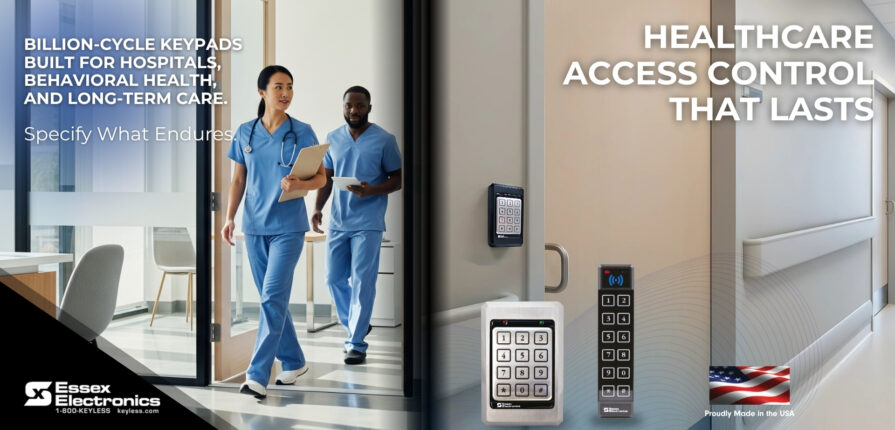
In healthcare settings, where frequent sanitization with harsh chemicals is mandatory, traditional keypads often fail within months. Essex keypads which utilize Piezoelectric switch technology maintain full functionality when exposed to:
- Bleach solutions
- Alcohol-based sanitizers
- Quaternary ammonium compounds
- High-temperature steam cleaning
Industrial Applications
Manufacturing environments present unique challenges:
- Vibration resistance: No moving parts means piezoelectric switches are unaffected by industrial vibration
- Contamination immunity: Sealed construction prevents dust, oils, and debris from affecting operation
- Temperature cycling: Solid-state operation maintains consistency across temperature extremes
Outdoor Installations
Weather exposure reveals critical differences:
- UV resistance: Stainless steel construction doesn’t degrade under solar exposure
- Freeze/thaw cycling: No materials expand or contract enough to affect operation
- Precipitation resistance: IP66 rating maintains protection in driving rain
Technical Specifications Comparison
| Feature | Piezoelectric | Industrial Mechanical | Membrane | Conductive Rubber |
| Cycle Life | 1+ Billion | 500K-5 Million | 1-5 Million | 750K-3 Million |
| Operating Temperature | -40°F to +160°F | Limited range | Limited range | Limited range |
| Humidity Rating | 100% RH | Variable | Variable | Variable |
| Response Time | <1ms | 5-20ms | 10-50ms | 10-50ms |
| Force Required | Fixed | Fixed | Fixed | Fixed |
| Tactile Feedback | Fixed | Fixed | Minimal | Variable |
Installation and Maintenance Considerations
Initial Installation
While piezoelectric keypads may require a higher initial investment, their solid-state construction offers reliable performance advantages:
- No moving parts to align or calibrate
- Durable stainless steel construction
- Consistent electrical connections
Long-term Maintenance
Traditional keypads require:
- Regular cleaning of contact points
- Replacement of worn mechanical components
- Periodic recalibration due to wear
- Environmental protection maintenance
Piezoelectric systems require:
- Basic exterior cleaning only
- No mechanical component replacement
- No recalibration needed
- Minimal ongoing maintenance
Cost Analysis: Beyond Initial Price
While traditional keypads often present lower upfront costs, total cost of ownership calculations reveal the true economic picture:
Year 1-2: Traditional keypads appear cost-effective Year 3-5: Maintenance and replacement costs begin accumulating Year 5+: Multiple traditional keypad replacements often exceed single piezoelectric system cost
For high-traffic installations (>100 actuations/day), the break-even point typically occurs within 18-24 months.
Specifying the Right Solution
When to Choose Piezoelectric
- High-traffic applications
- Harsh environmental conditions
- Chemical exposure environments
- Long-term installations where maintenance access is limited
- Applications requiring consistent performance over decades
Application-Specific Considerations
- Food Processing: Chemical resistance and easy sanitization requirements
- Marine Environments: Corrosion resistance critical
- Industrial Automation: Vibration and temperature cycling resistance needed
Future-Proofing Access Control Systems
As building owners increasingly focus on lifecycle costs and sustainable operations, the durability advantages of piezoelectric technology align with long-term facility management goals. The technology’s inherent reliability reduces:
- Emergency service calls
- Scheduled maintenance requirements
- Replacement part inventory needs
- System downtime incidents
Conclusion
Piezoelectric switch technology represents a fundamental advancement for demanding access control environments. The dramatic improvement in cycle life, environmental resistance, and maintenance requirements makes piezoelectric keypads the clear choice for installations where reliability and total cost of ownership are primary concerns.
For dealers and integrators, understanding these technical differences enables better system specification and positions your firm as a knowledgeable partner who considers long-term performance. The question isn’t whether piezoelectric technology is superior—the data clearly demonstrates that it is. The question is whether your applications can afford not to specify the most reliable technology available.
For technical specifications and application guidance on piezoelectric keypad solutions, contact Essex Electronics at 1-800-KEYLESS or visit keyless.com.