


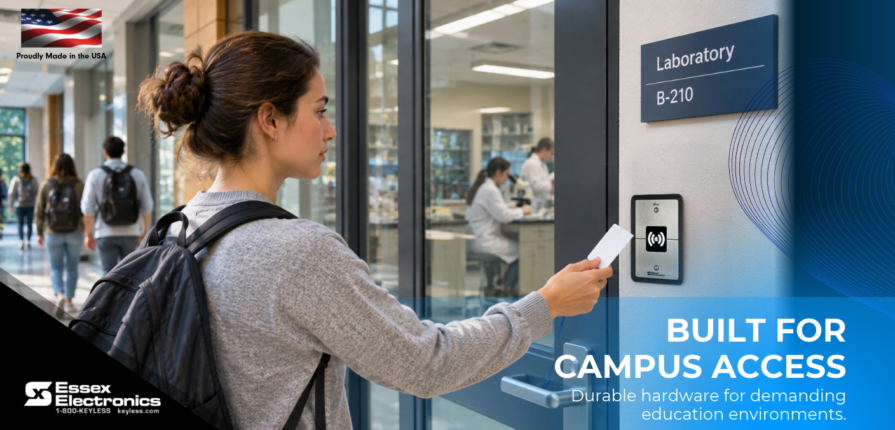
Access control hardware across a school or university campus has to accommodate a range of installation conditions. Exterior gates face weather and temperature changes, while interior doors in busy corridors can be exposed to impact and tampering. Credential systems also have to account for the cards students and staff already use, along with any plans for future upgrades.
For dealers and integrators, those considerations make product selection an important part of the specification. Essex Electronics offers rugged readers, piezoelectric switches, and touchless activation devices for projects where hardware construction, credential technology, or specialized design requirements deserve extra attention.
Start With the Conditions of the Opening
A contactless reader does not need to be physically touched to read a credential, but its housing can still be exposed to impact, tampering, and environmental conditions. The hardware needs to suit the location where it will be installed.
The Essex iRox™ Series combines stainless steel construction with epoxy-encapsulated electronics and a low-profile design. The readers carry an IP66 rating and are designed for vandal-prone applications. These features make iRox worth considering for campus openings where physical construction and environmental protection are important specification factors.
Request-to-exit switches deserve similar consideration. The PEB Series uses solid-state piezoelectric technology with no moving parts and has been tested to more than one billion cycles. Its 1/8-inch stainless steel faceplate, IP66 rating, and limited lifetime warranty against defects in materials and workmanship make it another option for demanding access control applications.
Plan for Existing and Future Credentials
Credential compatibility can complicate campus upgrades. A district may have thousands of cards already in circulation, making a complete replacement impractical within a single project or budget cycle. Some legacy 125 kHz proximity credentials also offer limited protection against copying, so administrators may want to consider more secure credential options over time.
The Essex iRox product family includes models designed to support different credential requirements. The iRox and iRox Pro operate at 13.56 MHz, while the iRox Plus and iRox Pro Plus also support 125 kHz proximity credentials. The dual-frequency models can help accommodate supported legacy credentials alongside compatible newer technologies.
The iRox Pro and iRox Pro Plus also support HID Mobile Access, including employee badge and Student ID credentials in Apple Wallet. For campuses considering mobile credentials, that gives integrators another option to evaluate during system planning.
Communication with the access control panel matters as well. Standard Wiegand output remains an option for many installations, while the iRox Pro and iRox Pro Plus offer field-selectable Wiegand or OSDP Secure Channel output. OSDP Secure Channel provides encrypted communication between compatible devices, provided the controller, wiring, and system configuration support it.
The following overview can help when comparing the available reader models. Confirm the exact credential formats and output requirements against the current product documentation before finalizing the hardware schedule.
| Reader model | Credential frequency | Output |
| iRox | 13.56 MHz | Wiegand |
| iRox Plus | 13.56 MHz and 125 kHz | Wiegand |
| iRox Pro | 13.56 MHz | Wiegand or OSDP Secure Channel |
| iRox Pro Plus | 13.56 MHz and 125 kHz | Wiegand or OSDP Secure Channel |
Consider the Other Side of the Door
Readers are only one part of campus access control. Request-to-exit switches and automatic door activation devices also need to suit the installation and the way people move through the building.
The Hand-E-Wave® touchless switch uses 24GHz Doppler Radar to detect motion within an adjustable 2- to 24-inch zone. Its bidirectional detection can recognize a moving hand, wheelchair, or cart, while timed or toggle output allows the switch to be configured for the application. The product is available in narrow, single-gang, and double-gang configurations, with several faceplate options.
For applications that call for a physical switch, the PEB Series provides adjustable output timing from 1 to 40 seconds, selectable red or green illumination, and jumper-selectable fail-safe or fail-secure relay operation.
Both the PEB Series and Hand-E-Wave carry UL 294 Access Control Line Security Level 1 certification. The appropriate switch and configuration will depend on the door hardware, access control system, and intended function.
Egress requirements also deserve attention during design. Confirm that the proposed door release arrangement complies with applicable building and fire codes, in coordination with the authority having jurisdiction.
Customization for Campus Requirements
Access control hardware is part of the campus environment, particularly at main entrances and other prominent doors. Essex offers customization options that allow schools and universities to incorporate their branding into the hardware.
The iRox Series supports custom logos and graphics, while RoxProx™ readers offer custom marking options. Hand-E-Wave also supports customized graphics, giving facilities additional options for maintaining a consistent appearance across reader and switch installations.
Essex designs and manufactures its access control products in Carpinteria, California. Its manufacturing operation includes electronics assembly, stainless steel fabrication, laser marking, encapsulation, final assembly, and testing. These capabilities support the company’s standard product line as well as documented customization options.
For a campus project with specific branding or product requirements, raise those details during the quoting and specification process so Essex can confirm the available configurations.
A Practical Checklist for Education Projects
Before finalizing the hardware schedule, review the requirements for each opening:
- Physical conditions: Could the reader or switch face impact, tampering, moisture, or extreme temperatures? Check the product’s construction and environmental ratings.
- Existing credentials: Identify the credentials currently in use and confirm which reader models support them.
- Future upgrades: If the campus is considering mobile credentials or OSDP Secure Channel, verify reader, controller, and system compatibility.
- Door operation: Determine whether the opening calls for a request-to-exit switch, touchless activation, or another release method. Confirm applicable egress requirements.
- Appearance and branding: Identify any custom graphics, finishes, or other documented options during specification.
Working through these requirements helps integrators select hardware that suits each opening while accounting for the wider access control system.
Specifying Access Control for Schools and Campuses
Education projects bring together a wide range of openings, credential requirements, and operating conditions. Reader construction, communication protocols, switch options, and customization can all influence the specification.
Essex Electronics offers products for these different needs, from rugged iRox readers and PEB Series switches to Hand-E-Wave touchless activation.
Specifying access control for a school or campus project?
Call 1-800-KEYLESS or visit keyless.com to discuss your application with Essex Electronics.